
The ISRO plans to send three Indians to space by 2022, an announcement made by Prime Minister Narendra Modi during his last Independence Day speech.
Nervous and anxious for sure but the city-headquartered space agency is cautiously optimistic of "Vikram" module's soft-landing on the Lunar surface planned in the early hours of Saturday.

An entire nation waited, praying and hoping fervently, as the countdown to touch down on the moon wound to a slow close on Wednesday with many thousands gathering in schools, places of worship and elsewhere and scientists doing last minute checks to ensure Chandrayaan-3 makes a soft landing on the lunar south pole.

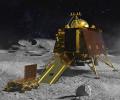
India is now on the Moon and the success of the lunar mission has sounded the bugle for the emergence of a developed nation, Prime Minister Narendra Modi said on Wednesday as Chandrayaan-3 landed successfully on the lunar surface.

The Sarabhai Crater is around 250 to 300 kilometres east of the crater where the Apollo 17 and Luna 21 Missions had landed.

"It is going to be the most complex mission ever undertaken by ISRO. It is going to take place between July 9 and 16, this year," Sivan said, addressing scientists from the Mission Control Centre.

Chandrayaan 3 follows the Chandrayaan 2 mission which did not achieve the desired soft landing on the surface of the moon in 2019, disappointing the scientists.
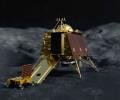
Conducting in-situ scientific experiments is underway. All payloads are performing normally, ISRO said.
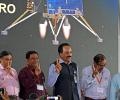
While the historic success of Chandrayaan-3 is celebrated by Indians across the world, two untrumpeted engineering colleges in Kerala are basking in the glory of the key role played by some of their alumni in the crucial Moon mission.

The COVID-19 lockdown has hit several projects of the ISRO including Chandrayaan-3, which was scheduled to be launched in late 2020, and Gaganyaan, the country's first manned space mission.

A photo of the prime minister hugging Indian Space Research Organisation chief K Sivan after a last-minute setback that led to the loss of lander Vikram, was also put on display for visitors.

"The receiver is kept on. Hoping for a successful awakening for another set of assignments! Else, it will forever stay there as India's lunar ambassador," it said.

Its duties include experiments to further understand the lunar surface.
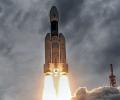
"The duration of manoeuvre was 1,738 seconds. With this, Chandrayaan-2 was successfully inserted into a Lunar orbit," Indian Space Research Organisation said.
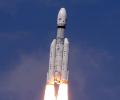
'ISRO takes a very cautious approach.' 'After reaching the moon, the orbit has to be brought down from a single elliptical orbit to a circular orbit while simultaneously ensuring the stability of Chandrayaan 3 and the health parameters of the lander and rover.'

'You declare a date, time and place for the landing two months in advance and exactly at that moment, it touched on the moon.'

Scientists also expressed the hope that any technical problem will be sorted out by ISRO, and the mission will be launched successfully.
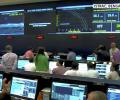
'The unflappable temperament and nerves of steel under extreme pressure -- essential ingredients in space research -- were on full display in the rows occupied by the scientists still engrossed in their monitor screens,' says Minnie Vaid, author of Those Magnificent Women And Their Flying Machines, ISRO's Mission to Mars.

Modi, in his address at the ISRO centre asked the scientists not to get disheartened by the hurdles in the lunar mission Chandrayaan-2 and asserted that there will be a "new dawn".
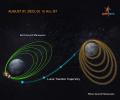
The Propulsion Module (PM) of Chandrayaan-3 has been moved from an orbit around the Moon to an orbit around Earth, the Indian Space Research Organisation (ISRO) has said, terming the operation a unique experiment.

Indian Space Research Organisation's plan to soft land Chandrayaan-2's Vikram module on the Lunar surface did not go as per script in the early hours of Saturday, with the lander losing communication with ground stations during its final descent.

'The ISRO has done enough simulations and also redundancies have been built in so that chances of such failure are remote. Still, we have to keep our fingers crossed'

Chandrayaan-2 was launched on July 22, 2019 and inserted into the lunar orbit on August 20, exactly one year ago.
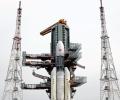
India's second mission to the moon will be launched on Monday at 2.43 pm after its initial launch on July 15 was called off owing to a "technical glitch."

The Rs 978 crore mission, which has been rescheduled for Monday after scientists corrected the glitch in the rocket, will be launched at 2.43 p.m from the second launchpad at Satish Dhawan Space Centre, over 100 km from Chennai.

Meet Indian Space Research Organisation scientist Ningthoujam Raghu Singh, who was one of the bright sparks responsible for sending Chandrayaan-3 to the moon.

'How many jobs will be created when you complete your course?' 'How many people will compete with you?' 'What is the minimum and maximum salary you can expect?' 'Which are the companies that will offer you a job?' 'What skills do you have to develop?' 'How long will it sustain?'
According to ISRO officials, Earth bound orbit is a phase during which the spacecraft will remain in the Earth's sphere of influence.
'When you look at it from the point of view of science, Chandrayaan 2 is a big success.'

The crater was formed during the Nectarian period, which dates back to 3.85 billion years and is one of the oldest time periods in the Moon's history, the team, including researchers from the Physical Research Laboratory and Indian Space Research Organisation (ISRO), Ahmedabad, said.

The Laser-Induced Breakdown Spectroscope instrument onboard 'Pragyan' rover of Chandrayaan-3 has 'unambiguously confirmed the presence of sulphur in the lunar surface near south pole, through first-ever in-situ measurements,' ISRO said on Tuesday.

Russia's state space corporation, Roskosmos, according to the Reuters report, said it had lost contact with the spacecraft shortly after a problem occurred as it was shunted into pre-landing orbit on Saturday.
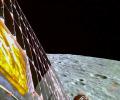
According to the Indian Situational Space Awareness Report for 2023, the nominal lift-off of the Launch Vehicle Mark-3, carrying the Chandrayaan-3 spacecraft, had to be delayed by four seconds based on the Collision on Launch Avoidance analysis.
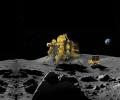
This eagerly anticipated event will be broadcast live on August 23, starting from 17:27 Hrs IST on multiple platforms, including the ISRO Website, its YouTube channel, ISRO's Facebook page, and DD National TV channel.
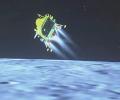
After Chandrayaan-3 touched down on the Moon, the Congress on Wednesday said it is a collective success of every Indian and ISRO's achievement reflects a saga of continuity and is truly fantastic.
A number of private companies have contributed to the development of ISRO's Chandrayaan-3 spacecraft which successfully landed near the south pole of the Moon on Wednesday evening.
The Chandrayaan-2 spacecraft is expected to reach the moon's orbit on August 20 and land on lunar surface on September 7.

All spacecraft parameters are normal, the Bengaluru headquartered space agency said after the maneuver on the spacecraft.
There will be two more orbit manoeuvres to make the spacecraft enter into its final orbit passing over the lunar poles at a distance of about 100 km from the Moon's surface.

All spacecraft parameters are normal, the Bengaluru headquartered space agency said after the maneuver.
